
27. Athens
“Of the Greek city-states, Athens in Attica became by far the most important in the history of art… It was also at this time when Athenian democracy had reached its height… The temples in the sacred rock of Athens, the Acropolis, had been burned down and were to be rebuilt in marble and with splendour and nobility never known before… The Parthenon had been built in the Doric style, but in the later buildings on the Acropolis the forms of the so-called Ionic style were introduced (where) the whole appearance and character are different… and at its most perfect the temple called the Erechtheion… with columns much less robust and strong, like slender shafts with the capitals richly decorated.” *
The ‘Acropolis’ as a large limestone rock was used by original inhabitants of the city-state of Athens for shelter, defence and worship.
With its steep sides and large flat top, it was a most unusual physical feature.
This ‘akropolis’, meaning upper city, was the central site around which the city-state was built.
Most of the buildings in the city were located near the base of the Acropolis so that it would be easy for the inhabitants to take refuge on the protected sides or on top of the rock.
A series of cyclopean walls were also built as fortifications during the Mycenaean era with large unevenly stacked stones.
After invasion by the Persians and destruction of the old temple, the Athenians had to rebuild.
The new octastyle monument dedicated to Athena was built in marble, ‘the Parthenon’ with the ‘virgin’s apartment’ containing an enormous statue of Athena, with wooden roof and series of fine Doric columns shaped by entasis and with decorated sculpted gable pediments at each end.
Other significant structures also were built on the acropolis, the ‘Propylaea’ entranceway, the elevated tetrastyle ‘Temple of Athena Nike’ (the ‘bringer of victory’) and the elegant hexastyle ‘Erechtheion’ with its four caryatids, each of which brought individual contributions to the architectural hierarchy around the Parthenon.
Besides the Acropolis, the other striking natural geophysical feature in the centre of Athens is ‘Lykabettos Hill’, another limestone rock outcrop with twin peaks, with an amphitheatre crafted at the top of the hill.
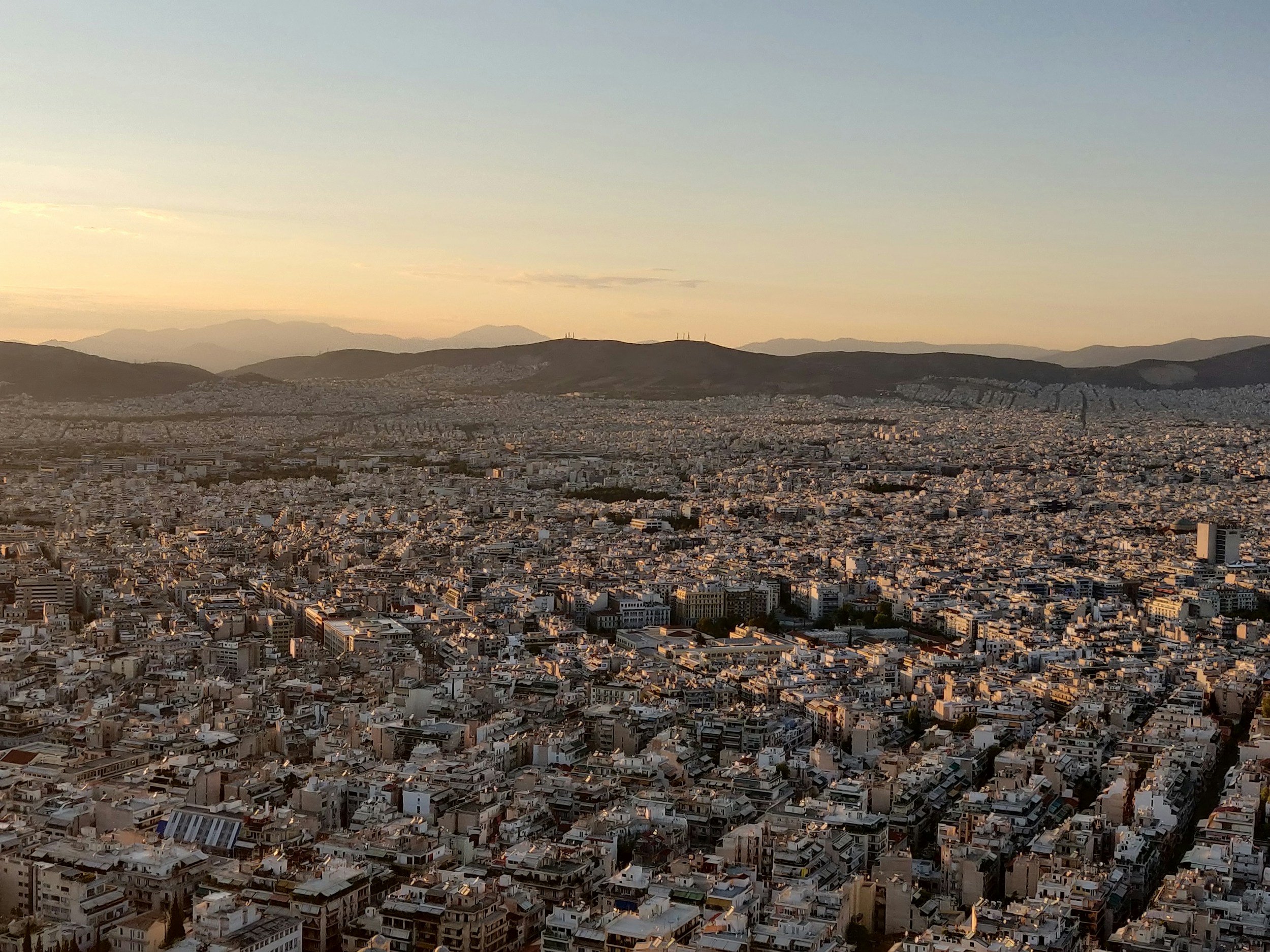
These two rock outcrops are defining features in the centre of the city with the adjoining Kolonaki neighbourhood, and around which the dense urban fabric of the city has developed.
Besides the Roman Agora, within a triangle formed by the Kerameikos cemetery along Ermou Avenue to the Parliament Building and Syntagma Square and the Acropolis is Plaka, by Monastiraki Square, the former heart of Ottoman Athens, a densely packed neighbourhood of cobblestone streets, with its whitewashed houses and local tavernas.
From Omonia Square running northwards is ‘31st September Avenue’ highway and the early railway line towards Kifissia, now converted into Metro Line 1.
Running southwards are the highways ‘Leoforos Eleftherios Venizelos’ and ‘Andrea Syngrou’ that run towards the port of Piraeus as the urban fabric is interspersed with major streets and avenues filled with present day traffic.
With its hilly surroundings, the new underground Metro Lines 2 & 3 are contributing to alleviating urban traffic congestion.
The newly planned infrastructure as run by ‘Attiko Odos’ that encircles the north of the city which connects with Athens International Airport (ATH) at Spata has transformed outer traffic movements.
However, appropriate traffic management measures, dedicated lanes and upgraded facilities are still vital within the centre upon which the future mobility and air quality of the modern city depends.
*Ernst Gombrich – The Story of Art – Phaidon Press, 1950.