28. Barcelona
The major transformation of the city of Barcelona occurred in the mid 19th century.
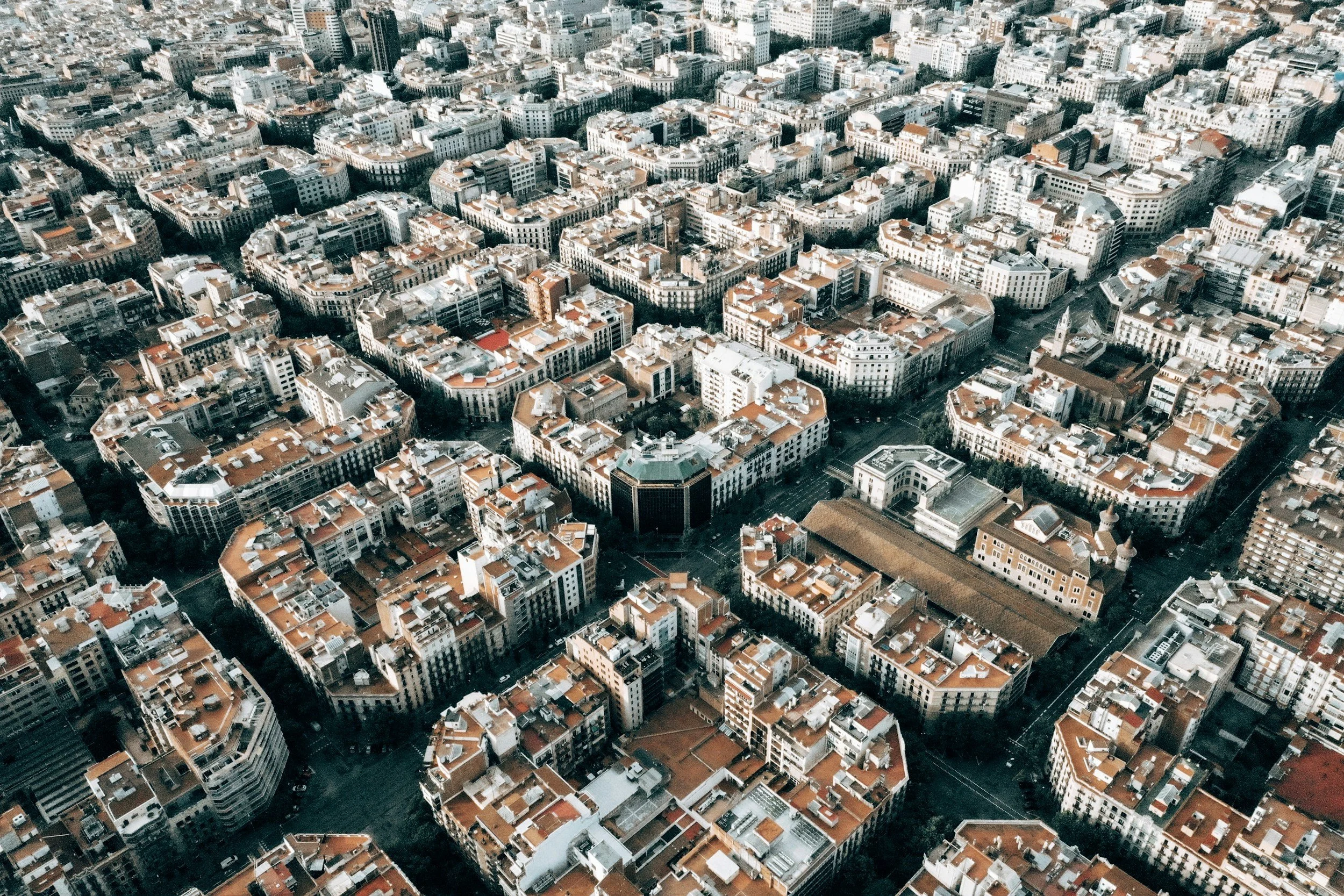
In response to a competition for a new town plan held by the Ajuntament of Barcelona, the Catalan engineer Ildefonso Cerdà drew up a plan for a grid layout of squares that enclosed the Old City.
To the east of the north-south railway division of the city along the Rambla de Catalunya, the focus of its series of new grid blocks was at the crossing of three great avenues that slice across the Eixample today: Avinguda Gran Via de les Corts Catalanes, Avinguda Diagonal and Avinguda Meridiana which intersect at the renamed Plaça de les Glòries Catalanes.
“With its equality of space and undifferentiated fabric of blocks, it was laid out by Cerdà as follows: he had envisioned 550 blocks covering a land surface of nearly 9 square kilometres. But this grid was absolute. It bore no relation to the site, it could be expanded for ever, a purely modular city. Each district of 400 blocks (20 x 20) would have its own hospital, park etc. Each of these districts would be further sub-divided into four units of a hundred blocks (10 x 10), each unit with its own subsidiary services. And each of these 100 block units would further break down into four ‘barris’, each of 25 blocks (5 x 5) with its own schools and care centres. Only about a third of each block was to be covered by buildings and the corridors of open space between the apartments were to be patio gardens lined with plane trees. Every block would be 113.3 metres square, and the streets between them 20 m. wide, three blocks plus three street widths thus equalled 400 metres. But each block would have its corners chamfered at 45 degrees forming little diagonally set open squares at the intersections.
However, Cerdà’s original provision for the blocks went by the board. From the fortress like character of the blocks one could never guess that he actually meant them to be open. The Ajuntament let developers deepen the blocks, thus narrowing the gardens. Then the inside of the blocks and gardens were covered by single storey structures. Next developers would close off both open ends of the block with multi-storey buildings. And then once the block was fully utilised the height of all the buildings was increased. And in the Franco years a rush of attics was added to existing buildings all over the Eixample, so today it is far denser and higher than Cerdà could have imagined. Probably the only variation that added something was the building of ‘passatges’, passageways, private streets lined with houses that cut across some of the blocks and provide oases of intimate scale in the grid”. *
Despite such setbacks, this planned ‘expansion’ of the old city has developed into a series of different neighbourhoods as Dreta de l’Eixample, Antiga Esquerra de l’Eixample and Sagrada Familia.
With its ‘modernista’ architecture, unusual buildings and chamfered street corners, the Sagrada Familia Basilica and Casa Milá as designed by Gaudi are key features in the area just as the Passeig de Gràcia Boulevard dominates the street scene.
This unique ‘Eixample’ of Barcelona remains one of the most interesting and vibrant central urban areas in Europe recognisable with its dedicated street names of Catalan places, people and heroes.
*Robert Hughes – Barcelona – HarperCollins, 1992.