
26. Moscow
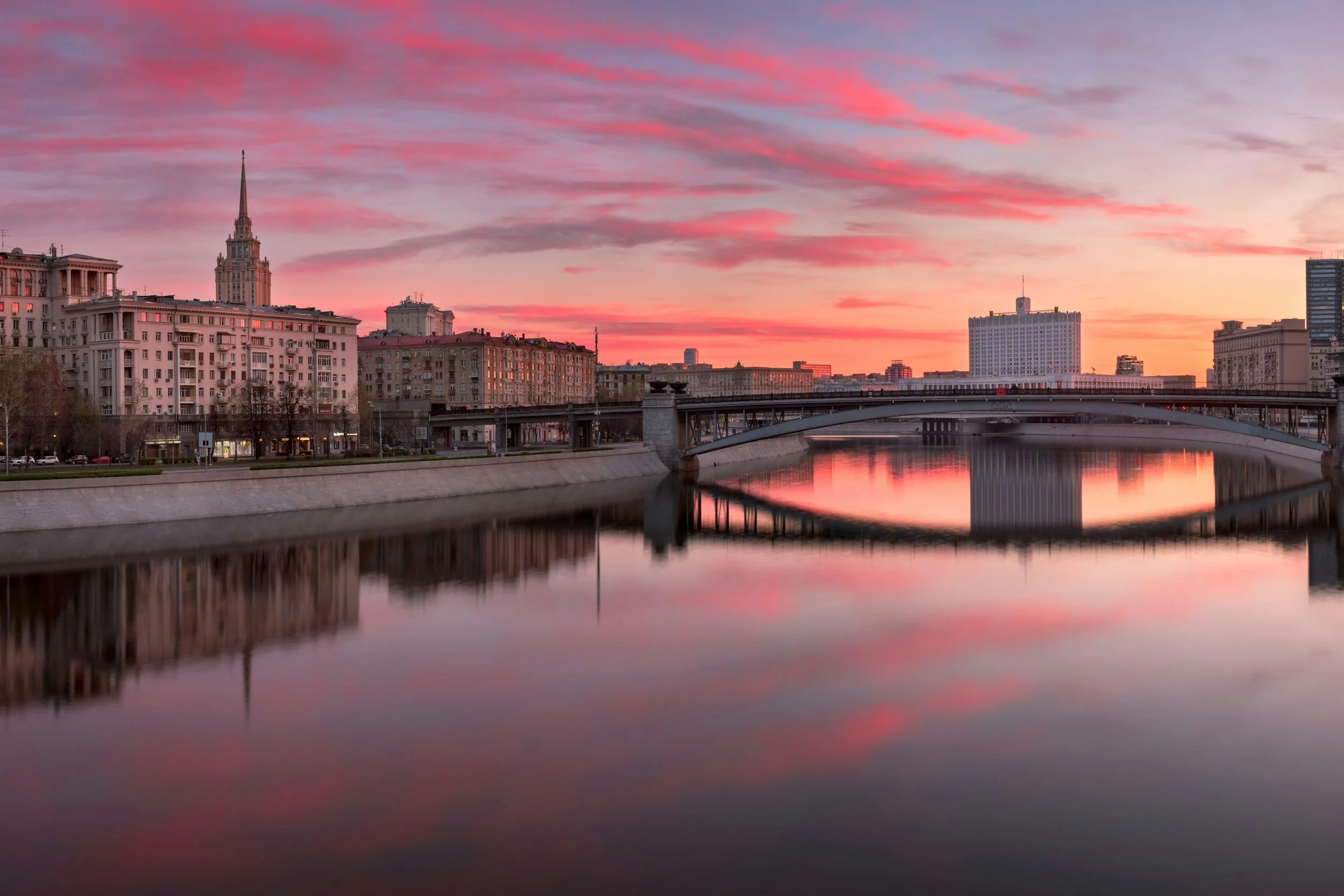
“Moscow was a city surrounded by the waters of six rivers. It had begun its existence as a settlement at the foot of a hill, the Borovitsky Hill, on the north bank of the Moskva River. Here a fort had been built in the twelfth century and thereafter, the place grew and prospered when the Metropolitan of the Russian Orthodox Church moved his see here and Ivan III, the Great, extended the frontiers of the surrounding empire. He reconstructed the castle of the town, the Kremlin, which he enclosed within massive walls and towers, which still encircle the Kremlin, built of red brick. Several stone churches had already been built within the walls and to these were added the five-domed Cathedral of the Assumption and also the Cathedral of the Archangel Michael in Renaissance style finished in 1509… During the 18th century the city continued to expand. New churches and hospitals were built; the monumental Senate building in the Kremlin was designed and built, along with noblemen’s houses facing the street or standing behind a winged forecourt with gardens at the back, which towered above the small wooden houses in which the majority of Moscow’s people lived”. *
For many people, the Kremlin symbolises the external view of the city of Moscow, with its scale and solidity.
With its formidable solidity and industrial state, its commissariats and constructivist history, another less visible strength is its expansive Highway infrastructure plus the Metropolitan underground system that was built with grand stylised cathedral like stations following the Moscow General Plan.
Officially ‘V. I. Lenin Metro’, construction commenced in 1935 and has expanded from its first Line to a complex network covering 400 kilometres with over 250 stations.
Besides its spoke & hub system and radial nature, it contains three circular lines, the Koltsevaya, the Moscow Central Line and the Bolshaya Koltsevaya Lines that circumnavigate the city.
Of Russian gauge (1520 mm), the electrified railway (METPO) is a state-owned enterprise built in stages that is continuing to be extended outwards into the suburbs.
Besides its early palatial underground stations, the later lines that have been built were more utilitarian with repetitive concrete column supports.
Many stations which are very deep with long escalators for access, were designed to act as population shelters and bunkers.
The network crosses the Moskva River several times at multiple locations and complements the suburban railway service provided by the restructured ‘Russian Railways’ (OAO RZhD).
It is able to connect more distant suburbs with a reach of over 15 million people whilst carrying a daily ridership of around 7.5 million passengers.
While having as wide a coverage as the Beijing network, its age and condition does not match the functionality, performance and inter-connectivity of the more modern Sino system.
*Christopher Hibbert – Cities and Civilizations – Weidenfeld & Nicholson, 1987.